- Home
- Child Custody
- Child Custody Agreement
What Should Your Child Custody Agreement Include?
By WomansDivorce, updated by Tracy Achen
Every state requires parents with minor children to create some type of child custody agreement to be included with their divorce or legal separation agreement. This agreement becomes the legal document which details how the children will be taken care when their parents are living separately.
Different states use different terms to describe this type of agreement, including
- child custody agreement
- parenting agreement
- custody and visitation agreement
- parenting plan
In some states, there is a difference between a custody agreement and a parenting plan. In these states, a custody agreement is a legally binding court order. Whereas, a parenting plan is a voluntary agreement between the parents that only becomes enforceable when it is submitted to the court and incorporated into a custody order (1).
It's important to look up the exact requirements for your state concerning custody agreements, because there may be specific rules about what must be included. Fortunately, the basic custody agreement is similar regardless of the state, so there are some general requirements that everyone should have in their agreement.
What to Include in Your Child Custody Agreement
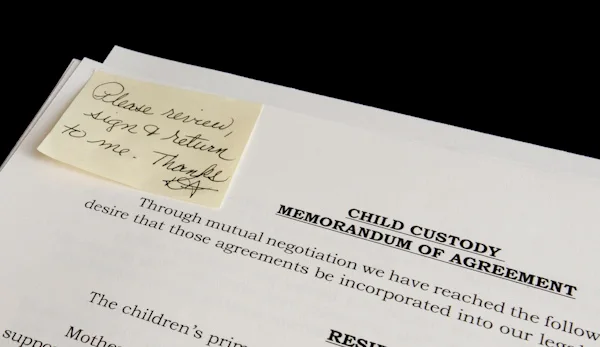
Most child custody agreements detail parental rights, legal and physical custody, the visitation schedule, and how other important issues concerning the children will be handled. Here are some of the fundamental factors to include in your custody agreement.
Custody Provisions
Custody provisions and stipulations provide extra rules and requirements that you and the other parent must follow. The best custody provisions are ones that focus on the best interests of your child or children. For example, many states require that parents include information about legal and physical custody and how you and the other parent will share and divide up the various parenting duties.
- Legal custody refers to decision-making authority for the children.
- Physical custody refers to where the children will live.
Joint legal custody means both parents share decision-making authority and responsibilities for their children, while sole legal custody means one parent has exclusive rights to make those decisions. Physical custody determines whether the children will live mainly with one parent or equally with both and who is responsible for their daily needs.
Parenting Schedule
The bulk of the agreement will be your child visitation schedule. This is also called a parenting time schedule because it shows the parenting time for each parent. To make a complete schedule, you and the other parent should make a basic schedule of custody and visitation which will repeat on a weekly or monthly basis. This is the normal routine that you follow regarding where the children spend their time.
Along with this, you also need to develop a schedule for the various holidays, school breaks, and vacation times. This shows which parent the children will be with during the different holidays, and the specifics about how you and the father will share summer vacation-time with the children. Including all of these things will produce a schedule that shows where the children are at all times.
You may also want to include information regarding parenting time exchanges. If you and the other parent live in the same area, you can detail where the children will be dropped off and picked up, along with the corresponding times. If there are longer distances involved, you will need to address meet-up locations and sharing costs for long distance transportation.
Child Support and Other Financial Issues
Every state has an exact calculation it uses to determine child support. You and the father must each fill out the proper papers so the state can figure out who pays the support and the amount. These papers and the child support calculation are included in the child custody agreement.
Other financial issues to address may include which parent is responsible for providing health insurance, how uninsured medical expenses will be paid, and who will pay for private schooling or extracurricular activities.
Additional Provisions to Consider
Another possible provision to include in your custody agreement is how you and your ex will communicate with each other regarding the children. This could be through text, phone calls, emails, or parenting apps. You may also want to include how you will share your children's school and medical information. It is also helpful to address how a parent can communicate with their children when they are with the other parent.
Many parents also include a relocation clause that details what happens when the custodial parent moves out of the area. It can address how far a parent can move without consent, what type of notification is needed, whether court approval is required, and how the visitation schedule will be impacted.
You can also add stipulations about:
- how disputes will be resolved,
- how future changes to the agreement will be made,
- the requirements for traveling with the children,
- how your children's extra-curricular activities will be handled
The provisions you add can be customized to your situation so they fit exactly what you want.
Common Custody Agreement Mistakes
The best custody agreements are child focused, flexible enough for life’s inevitable changes, and written in such a way as to minimize future conflicts. Some common mistakes parents make, especially when drafting their own agreement, include:
- Being too vague
- Ignoring holidays
- Forgetting transportation
- Not including communication rules
- Not addressing future changes
- Leaving relocation unaddressed
- Omitting dispute resolution provisions
It's a good idea to make sure everything you want is included in your custody agreement, because there are restrictions on when it can be changed. In most states, there is generally a one to two year waiting period before any major modification can be made, unless both parents agree to the changes or there has been a significant change in circumstances.
Whether you’re drafting your own agreement or having an attorney do it, it’s a good idea to think through all the issues beforehand. The Essential Divorce Planner has a parenting plan worksheet which can help you determine what you want included in your agreement.
Frequently Asked Questions
Can parents write their own child custody agreement?
Can parents write their own child custody agreement?
Yes, parents can draft their own custody agreement, as long as it complies with state laws for court approval. Even so, it is a good idea to enlist the services of a family law attorney in the process before signing anything. You and you spouse can work out the main details of your agreement and then have your attorney review it to make sure it covers everything. The lawyer can also submit the final custody agreement to the court.
What makes a custody agreement legally enforceable?
What makes a custody agreement legally enforceable?
To be legally enforceable, the custody agreement needs to be submitted to the court, approved by a judge, and made into a court order.
Can a custody agreement be changed later?
Can a custody agreement be changed later?
It can be changed if both parents mutually agree to the changes. If they don't agree, there needs to be a significant change to the parenting arrangement, such as documented safety concerns, a change in a parent's work schedule, or relocating a significant distance for the agreement to be modified. The parent seeking to change the custody agreement needs to file for a modification with the court.
What happens if one parent violates the agreement?
What happens if one parent violates the agreement?
If a parent violates the custody agreement, the other parent can file a motion for enforcement with the court. This may result in the custody agreement being modified or the offending parent facing fines or jail time. Be sure to keep track of the various violations so that you have proof of what has occurred in case you have to go back to court to have the agreement enforced.

Tracy Achen is a Certified Divorce Transition Coach and founder of WomansDivorce.com, which she launched in 2001 after her own divorce to give women the support and information she lacked. She has researched and written on all aspects of divorce, helping women make informed decisions and rebuild their lives afterward. She is the author of Divorce 101: A Woman’s Guide and The Essential Divorce Planner. Follow Tracy on LinkedIn.
Related child custody agreement information:
- What to include in your Parenting Plan
- Parenting Plan Template
- Online Custody & Visitation Calendar
- Creating A Child Visitation Schedule
References:
Prepare for Your Divorce
Get organized, understand what you’re entitled to, and confidently plan the next steps in your divorce with
The Essential Divorce Planner
Stay Up to Date!
Get exclusive articles, tips, and resources
Plus receive your FREE divorce ebook
Most Popular
Should You Sell Your Wedding Ring?
How to Create a Parenting Plan
Is a Divorce Attorney Really Necessary?

 RSS
RSS
Your Wedding Ring After Divorce
7 ideas on what to do with it
Free Divorce Mediation Checklist
Organize your path to resolution
Pitfalls of DIY Divorce
4 challenges to be aware of.
Make Divorce Less Stressful
4 key ways to reduce stress.
Recovering Financially from Divorce
How to regain stable financial footing.
Financial Documents for Divorce
Information needed for negotiating a fair settlement.
Best Way to Sell an Engagement Ring after Divorce
These tips can help turn your marriage bling into money.